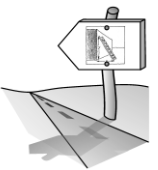
7.1.3Can I measure my shadow?
Related Rates Applications: Similar Triangles

Make a prediction: As Eric walks his shadow grows longer. Does it grow at an increasing rate, a decreasing rate or a constant rate? Explain.
Calculate the rate that Eric’s shadow grows when he is exactly
feet away from the lamppost. Show all work. Calculate the rate that Eric’s shadow grows when Eric was exactly
feet from the lamppost. Compare this to the rate you found in part (b). Was your prediction in part (a) correct? Just like the falling ladder problem, this problem involves right triangles. In the falling ladder problem, one side of the triangle changed at a constant rate and consequently, the other side did not. But, in this problem, both Eric’s distance and his shadow’s length grow at a constant rate. Why are the outcomes of these two problems different?
.png)
A large, underground water storage tank has the shape of a cone. It is
Make a prediction: Assume the tank is empty. As water is pumped into the tank, the depth of the water increases. If water is pumped into the tank at a constant rate, will the rate that the depth increases also be constant? Explain why or why not.
Sketch a diagram that relates the depth,
, of the water with the diameter, , of the surface of the water. Then write an equation that relates the depth and diameter at any time. If water is being pumped into the empty tank at the constant rate of
gallons per minute, how fast is the depth of the water changing minutes after the pumping starts? ( ) Write an equation that relates the amount of water in the tank with the depth of the tank.
Convert the equation into a rate equation.
Evaluate the rate equation.
Was your prediction in part (a) correct? Why or why not?
With your team, write a set of steps for solving a related rates problem.

Differentiate each function. Homework Help ✎
Use your results from problem 7-27 to integrate each expression below. What do each of the problems have common? Homework Help ✎
Greta is trying to solve the equation
Rewrite Greta’s equation using
, then solve for . If
, what is the value of ?
Consider the equation
What is
? Write the equation of the line tangent to the curve at
. If
, estimate using the tangent line. Using
, determine if the tangent line approximation is an overestimate or an underestimate. Justify your answer in words.
If Hoi Yin’s hair is of length
A right triangle has a fixed hypotenuse of length
In order to plan for the future water supply, the average population of the world is needed. If the world population in 2015 was about
.png)